What is High Sensitivity Geophone 4.5Hz ?
Principles and Characteristics of High-Sensitivity Geophones
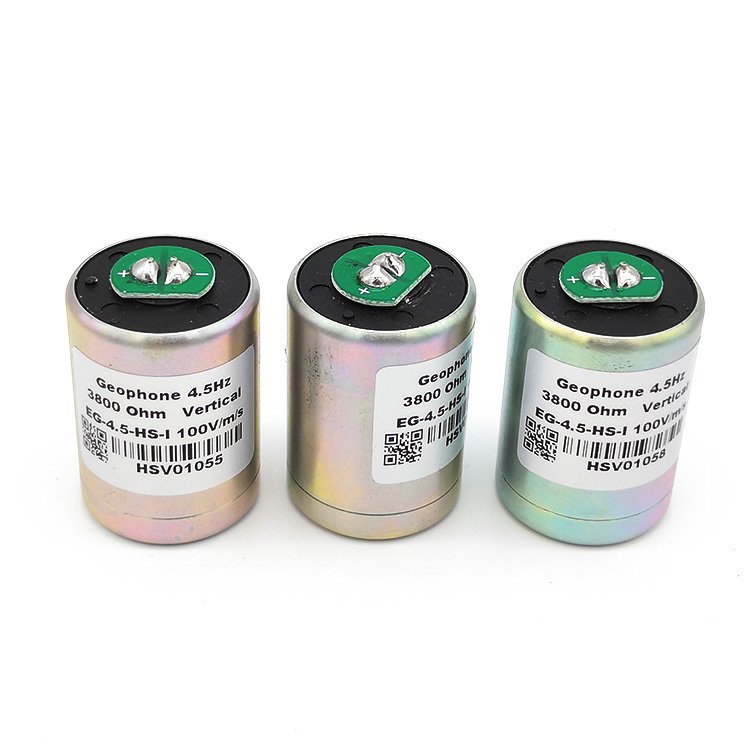
A high-sensitivity geophone is a precision ground-motion transducer designed to detect extremely small particle velocities generated by seismic waves. Unlike standard geophones, which typically offer sensitivities between 20–30 V/m/s, high-sensitivity variants elevate the output substantially, enabling clearer signal capture in environments with low seismic energy. The EG-4.5-HS-I High Sensitivity Geophone 4.5 Hz exemplifies this design philosophy, delivering a sensitivity rating of 100 V/m/s, which is significantly above conventional 4.5 Hz units. This sensitivity enhancement improves the amplitude resolution of weak reflections and boosts signal intelligibility during data acquisition.
The working principle remains based on the moving-coil mechanism, where ground vibration induces relative motion between a suspended inertial mass and a magnetic field. However, high-sensitivity models adjust parameters such as coil turns, magnetic flux density, and damping characteristics to increase electrical output for a given particle velocity. These design optimizations allow the sensor to detect low-energy seismic events, microseismic activity, and subtle subsurface contrasts that might be missed by standard sensors. In advanced exploration campaigns, this heightened sensitivity plays a critical role in increasing seismic data fidelity.
A 4.5 Hz natural frequency, as provided by the EG-4.5-HS-I High Sensitivity Geophone, makes the unit well-suited for broadband surface seismic surveys, engineering investigations, and passive monitoring applications. The combination of low natural frequency and high output allows the instrument to respond efficiently to low-frequency seismic components that contain essential geological information. This performance characteristic supports deep-target imaging and enhances the stability of the recorded wavefield in varied field environments.
Functional Advantages in Seismic Acquisition
High-sensitivity geophones provide substantial advantages in survey conditions where ambient noise levels are low or subsurface reflectivity is weak. In exploration scenarios such as deep stratigraphic plays, hard-rock environments, or thin-bed detection, reflection amplitudes may be significantly lower than standard sensor thresholds. The EG-4.5-HS-I’s sensitivity of 100 V/m/s ensures a stronger electrical response, enabling seismic systems to capture these faint signals with greater precision. As a result, processing workflows benefit from improved signal-to-noise ratios, reducing reliance on aggressive filtering or amplitude-boosting algorithms.
In passive seismic monitoring, high-sensitivity geophones excel at capturing low-magnitude microseismic events generated by hydraulic fracturing, reservoir compaction, or natural tectonic activity. The increased voltage output allows monitoring networks to detect event signatures at greater distances or under less-than-optimal coupling conditions. This expands the effective aperture of monitoring arrays, contributing to improved event location accuracy, fracture interpretation, and real-time reservoir management. The EG-4.5-HS-I’s design ensures stable, linear response within its operational bandwidth, enabling consistent long-term monitoring performance.
Operational efficiency is further achieved because high-sensitivity sensors reduce the need for large-aperture spreads or the deployment of denser receiver arrays. With stronger and more coherent waveforms, acquisition teams can optimize layout configurations while maintaining data quality standards. This capability proves valuable in cost-constrained projects or in remote terrains where logistical challenges impact sensor deployment. The enhanced fidelity provided by instruments such as the EG-4.5-HS-I High Sensitivity Geophone supports high-resolution imaging objectives without imposing unnecessary operational overhead.
Instrument Design, Calibration, and Application Domains
The construction of high-sensitivity geophones requires stringent mechanical and electromagnetic precision. Beyond the moving-coil assembly, factors such as suspension alignment, mass-spring consistency, damping fluid characteristics, and magnetic circuit uniformity directly influence sensitivity performance. The EG-4.5-HS-I High Sensitivity Geophone leverages refined coil resistance, optimized damping ratios, and a highly stable magnetic structure to achieve its 100 V/m/s sensitivity level. These design parameters ensure low distortion, rapid stabilization, and reliable response in varying temperature and environmental conditions.
Calibration is critical for ensuring measurement accuracy, especially for sensors with elevated sensitivity levels. Laboratories typically verify natural frequency, open-circuit sensitivity, damping constant, and harmonic distortion using precision vibration tables and reference standards. For high-sensitivity sensors, even minor deviations in coil motion or mass alignment can influence output voltage significantly. Accurate calibration guarantees that the geophones will integrate seamlessly into seismic recording systems and maintain consistency across large channel counts or long-term deployments.
High-sensitivity geophones are deployed across multiple seismic disciplines. In petroleum exploration, they enhance reflectivity analysis for deep reservoirs and subtle structural traps. In engineering seismology, they are used for microtremor surveys, site characterization, and structural health monitoring. In mining applications, they support both active and passive seismic mapping for orebody delineation and stability assessments. With its 4.5 Hz frequency and 100 V/m/s sensitivity, the EG-4.5-HS-I is particularly suitable for high-resolution land seismic surveys, passive monitoring arrays, and any scenario requiring enhanced detection of low-amplitude waveforms.